

Journal
Surfing with Children in Agadir: A Parent's Guide
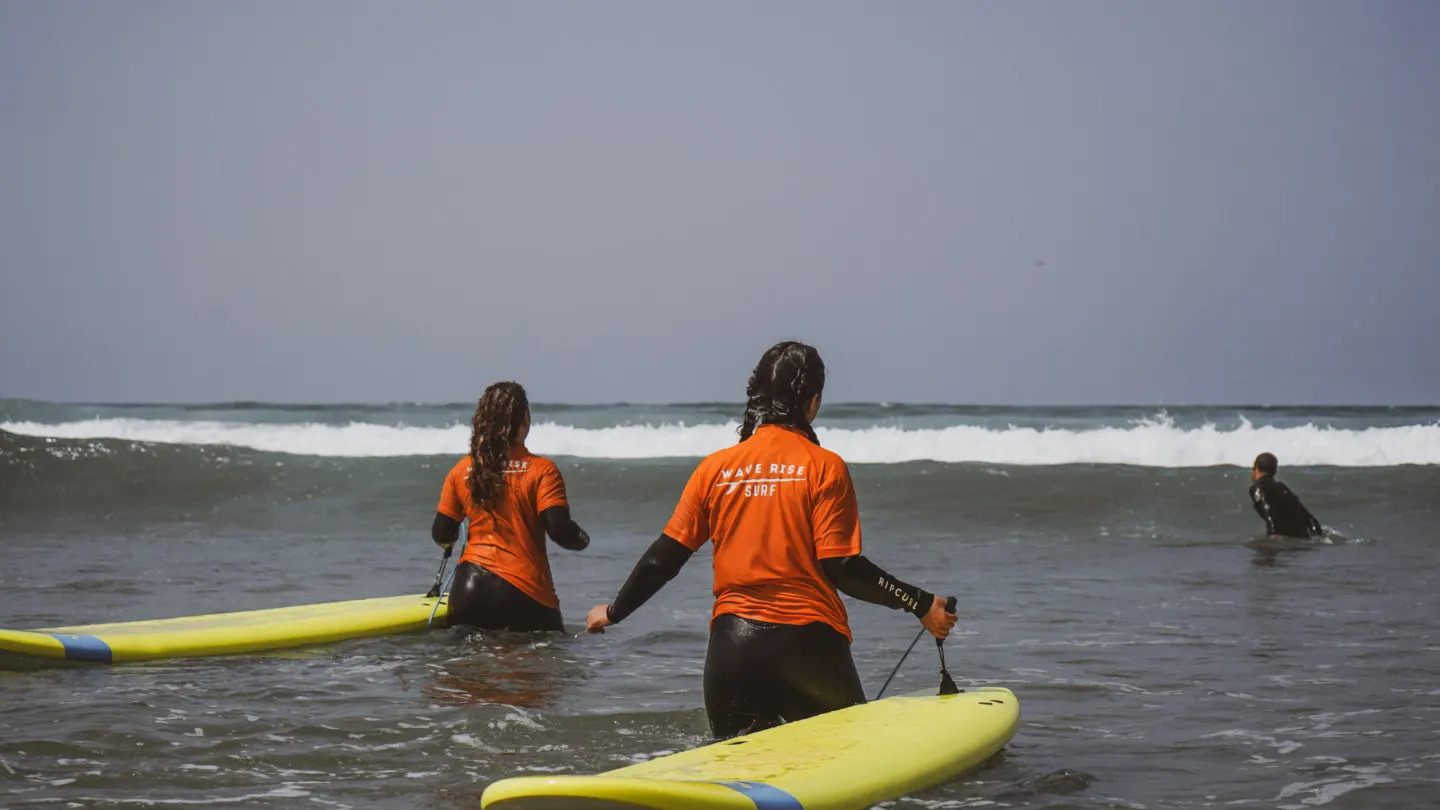
Agadir is an easy place to put a child on a surfboard. The beach is long and sandy, the bay is sheltered, the whitewater is where children surf anyway, and the water is mild for most of the year. This is what parents usually want to know before they book.
What age can children start?
The honest answer is that it depends far more on the child than on the number. What matters is whether they are comfortable in water over their waist, whether they can follow an instruction while excited, and whether they want to be there. A confident seven-year-old will have a better first session than a reluctant twelve-year-old. If you are unsure, tell us their age and how they are in water when you book and we will tell you honestly whether to go ahead.
Which lesson format works for children
For children we recommend the semi-private lesson, for two to four people, or a one-to-one private lesson. The reason is simple: attention. In a smaller group the instructor is beside them for every wave, correcting as it happens rather than a few minutes later, and can stop and reset the moment a child gets tired or spooked.
Both formats also include a photographer at no extra cost, which for most families turns out to be the thing they actually keep. The group lesson, for five to seven surfers, does not include the photographer.
Two families often book a semi-private together and take the whole slot, which works well because the children already know each other.
How long a session should be
We recommend two hours. It sounds long for a child, but the shape of it is forgiving: roughly twenty minutes on the sand learning to pop up, then water time in short bursts with breaks. Children rarely want to come out early once they have caught one.
Safety, plainly
- Children surf in the whitewater, in water they can stand up in.
- Boards are soft-tops — foam decks and flexible fins.
- The instructor is in the water with them, not watching from the beach.
- Wetsuits are included, and they float, which helps.
What to bring
A towel, sunscreen, a warm layer for afterwards and a snack. Everything else — board, wetsuit, equipment — is included. There are showers and lockers at the base, and a ping-pong table, which has ended more than one sibling argument.
If one parent does not surf
That is the normal case. The base is on the beach, so whoever is not in the water is sitting in the shade watching the whole thing rather than waiting at a hotel. Families often book one parent and child together in a semi-private and swap over the next day.
When to come
For children, the warm and gentle end of the year is easiest: May through September, with morning sessions before the wind picks up. Winter is perfectly possible in a wetsuit, but small children get cold faster than adults, and a shorter, warmer session leaves them wanting to come back.
What the first session actually looks like
Roughly twenty minutes on the sand: how to lie on the board, where to put your hands, how to pop up, and the safety points — hold the board on the far side of the wave, never between you and the beach. Then into the water in waist-deep whitewater, with the instructor turning the board and pushing them into waves. Most children stand up in the first hour. Almost all of them stand up in the first session.
Nervous children, and children who cannot swim confidently
Tell us in advance. It changes how the session is run rather than whether it happens: more time in shallower water, one wave at a time, and the instructor staying within arm's reach. A private lesson is worth the difference here, because the pace of the session becomes entirely theirs.
Brothers, sisters and competitive streaks
Siblings in the same semi-private lesson usually push each other along, and it works — up to the point where one is standing and the other is not. If there is a big gap in age or confidence, splitting them across two sessions, or a private lesson for the one who needs it, keeps the trip enjoyable for both.
Turning one lesson into something that sticks
One session is a nice memory. Three consecutive days is when a child stops being pushed into waves and starts finding them. The three-day and five-day packs run as consecutive two-hour sessions for exactly that reason, and for children the difference between day one and day three is the biggest jump you will see all week.
Common questions
What age can a child start surfing in Agadir?
It depends on the child more than the age. If they are comfortable in water above their waist, can follow an instruction and want to be there, they are ready. Tell us their age and how they are in water when you book and we will say honestly whether to go ahead.
Which surf lesson is best for children?
A semi-private lesson for two to four people, or a one-to-one private lesson. The instructor is beside them for every wave, and both formats include a photographer at no extra cost.
Is surfing in Agadir safe for kids?
Children surf in the whitewater in water they can stand up in, on soft-top boards with flexible fins, with the instructor in the water beside them. Wetsuits are included and add buoyancy.